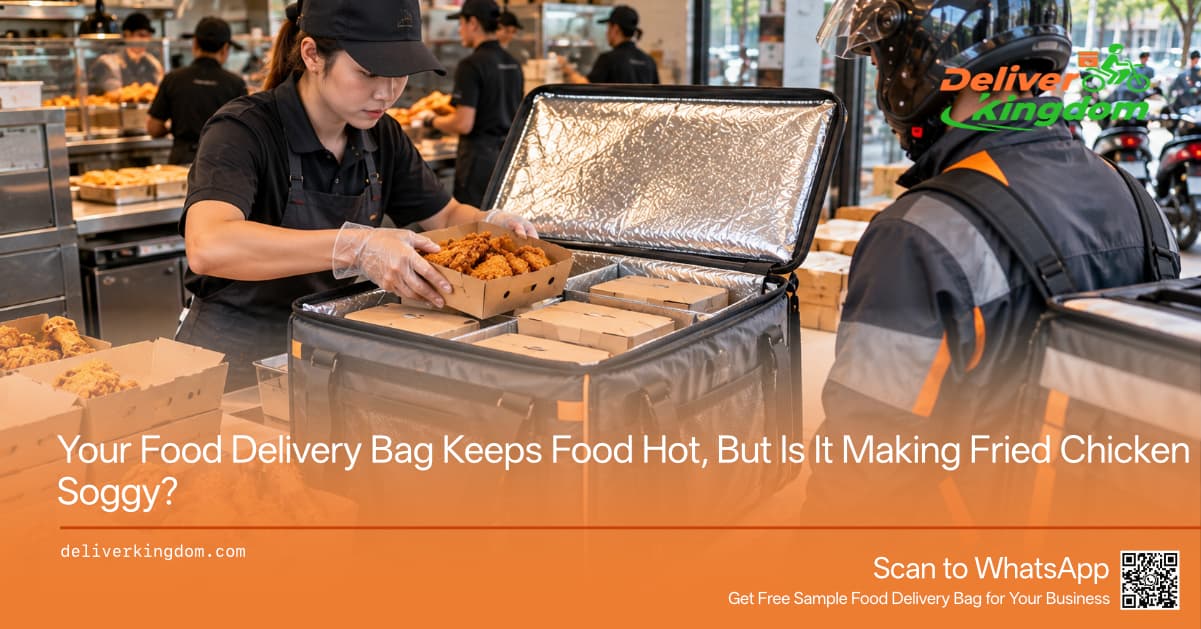
The Hidden Steam Problem Inside Insulated Food Delivery Bags
A fried chicken restaurant prepares a fresh order at 7:15 p.m. The chicken leaves the fryer hot, crispy, and ready for delivery. Restaurant staff place the sealed takeaway box inside a food delivery bag, and the courier starts a 30-minute journey through the city. By the time the customer opens the package, the food is still warm, but something has changed. The crispy coating feels softer, moisture has collected inside the takeaway box, and the eating experience is no longer quite what the restaurant intended. It is tempting to blame delivery time, but temperature is only part of the story. Hot food releases water vapor, and moisture can accumulate inside packaging and enclosed delivery spaces. When that vapor cools, condensation may form on packaging surfaces. A food delivery bag for fried chicken restaurants therefore needs to address more than heat retention. Packaging compatibility, insulation structure, internal airflow, and moisture management all influence the final result. DeliverKingdom has specialized in food delivery bag manufacturing since 2013, helping restaurant chains, takeaway operators, and food logistics businesses develop delivery equipment around actual commercial conditions rather than selecting products by appearance alone.
Why Hot Food Can Arrive Warm but Lose Its Original Texture
Restaurant customers rarely evaluate food quality using a thermometer. They notice whether fries are crispy, pizza crust feels fresh, fried chicken retains its texture, and paper packaging arrives dry. A meal can remain reasonably warm while still losing some of the qualities that made it appealing when it left the kitchen. This is especially noticeable with fried foods, where trapped moisture can soften the outer coating. A custom insulated delivery bag with moisture control features should therefore be considered as part of a complete packaging and transport system. DeliverKingdom can customize bag dimensions, inner lining materials, insulation thickness, opening structures, and removable compartments according to the food being delivered. For fried chicken chains, the design may need to accommodate packaging that allows controlled moisture release. For pizza restaurants, the bag must support wide boxes without crushing them while considering moisture accumulation during transport. For burger brands, separating hot sandwiches from cold beverages may help reduce conflicting temperature conditions. The objective is not to promise that an insulated bag can preserve freshly cooked texture indefinitely. Instead, the right food delivery bag can support packaging choices that reduce unnecessary heat loss, physical damage, and moisture-related problems during the journey.
The Relationship Between Thermal Insulation and Moisture Buildup
Insulation and moisture management are closely connected, but they do not always work toward the same goal. A tightly enclosed food delivery bag slows heat exchange with the surrounding environment, which is useful for hot meals. However, a more enclosed structure can also limit the escape of moisture released from food packaging. When warm, humid air contacts cooler surfaces, condensation may develop. Depending on the packaging design, this moisture can affect cardboard boxes, paper bags, and crispy foods. A food delivery bag for fried chicken restaurants should therefore be evaluated together with the takeaway containers being used, rather than treating the bag as an isolated product. DeliverKingdom offers customizable insulation structures using EPE foam, aluminum foil lining, PEVA lining, Oxford fabric, PVC-coated polyester, and other materials according to project requirements. The thickness and arrangement of these layers can be adjusted based on delivery distance, climate, bag size, and food category. A custom insulated delivery bag with moisture control considerations may also require changes to its opening structure or internal layout. The right configuration depends on actual testing because improving ventilation can reduce moisture accumulation while also increasing heat loss. Good thermal design is about managing that trade-off instead of assuming the thickest, most tightly sealed bag must always be the best.
Choosing Inner Linings That Are Easier to Clean and Maintain
The inner lining of a food delivery bag performs several jobs at once. It forms part of the thermal structure, protects underlying materials from food spills, and determines how easily the bag can be cleaned after repeated use. For businesses delivering fried chicken, burgers, pizza, and other hot takeaway products, grease and moisture can become recurring maintenance problems. Sauce may leak from a container, condensation may collect near the bottom, and food residue can accumulate around internal corners. If the lining absorbs liquids or is difficult to wipe clean, odors may develop over time. DeliverKingdom can customize food delivery bag interiors using PEVA, aluminum foil lining, coated fabrics, removable internal panels, and different structural arrangements. Smooth, suitable inner surfaces can make routine cleaning easier, while removable dividers allow staff to reach areas that would otherwise remain covered. A custom insulated delivery bag with moisture control requirements should also consider drying and storage procedures between shifts. For restaurant chains operating hundreds of delivery bags, convenient cleaning can reduce maintenance difficulties and help preserve a more professional appearance. Material selection should account for the intended cleaning agents and procedures, because not every lining is compatible with aggressive washing, high temperatures, or repeated machine cleaning.
Ventilation, Sealing, and the Challenge of Balancing Heat and Humidity
An insulated food delivery bag creates a practical engineering problem: too much air exchange can allow food to cool faster, while insufficient moisture release may contribute to humid conditions around certain takeaway packages. There is no universal ventilation solution for every food category. A bag carrying sealed rice containers may require different treatment from one transporting freshly cooked fried chicken in vented cardboard boxes. DeliverKingdom supports OEM and ODM development that allows buyers to customize closure structures, insulation layers, internal partitions, and selected ventilation features where appropriate. A food delivery bag for fried chicken restaurants may be developed to work with the restaurant's existing vented packaging, while a custom insulated delivery bag with moisture control features could use a layout that separates moisture-sensitive items from other meal components. Zipper closures, Velcro flaps, insulated lids, and optional ventilation openings can be evaluated according to the project. Any ventilation design should be tested because additional airflow can reduce thermal protection and may introduce rain or dust exposure if poorly positioned. For commercial buyers, the strongest approach is to define the actual problem first: whether the main concern is condensation inside takeaway boxes, moisture on the bag lining, temperature loss, or a combination of several factors. The product can then be developed around measurable requirements instead of generic claims about perfect insulation.
Custom Food Delivery Bags for Fried Chicken and Fast-Food Chains
Fast-food restaurant chains often have carefully standardized recipes, cooking procedures, and takeaway packaging, yet delivery bags may receive much less attention. A brand can spend considerable time selecting the right fried chicken carton or burger wrapper, then place everything into a generic thermal backpack that was designed without considering the menu. An OEM food delivery bag for restaurant chains provides an opportunity to connect packaging requirements with the actual delivery equipment. DeliverKingdom supports custom dimensions, fabric materials, insulation thickness, inner lining, divider arrangements, opening directions, reflective details, reinforced handles, and logo printing. For fried chicken brands, the bag can be sized around the standard takeaway boxes and designed to accommodate the chosen packaging system. For burger chains, removable partitions may help keep hot meals apart from cold drinks. For pizza brands, a wider horizontal structure can reduce tilting and protect box shape. Restaurant groups can also select Pantone-based color references and printing methods such as silk screen printing, heat transfer, embroidery, woven labels, and reflective printing. This makes the food delivery bag part of the restaurant's standardized equipment program rather than an afterthought. One approved design can support future store openings and replacement orders while maintaining consistent dimensions, colors, and branding.
Keeping Different Food Categories Organized During Delivery
A takeaway order rarely contains just one product. A fried chicken meal may include hot chicken, fries, a cold beverage, dipping sauces, and dessert. When everything is placed inside one large food delivery bag without proper organization, containers may shift and different temperature requirements become difficult to manage. Hot items can warm neighboring cold products, while beverage condensation or accidental spills may affect paper packaging. An OEM food delivery bag for restaurant chains can include removable dividers, upright drink holders, separate storage sections, reinforced baseboards, and transparent order identification pockets. DeliverKingdom can customize these components according to the actual meal combinations and delivery process. A fried chicken chain may prefer one insulated main compartment with a separate beverage section. A meal delivery company may require several horizontal levels to carry standardized lunch boxes. A catering operator may need larger compartments with reinforced handles for loading and unloading. A custom insulated delivery bag with moisture control considerations can also be developed to accommodate different packaging formats without forcing all food categories into one poorly organized space. Physical separation does not automatically create independent temperature zones, but suitable dividers and insulation can help reduce unwanted contact, movement, and certain thermal interactions. Better organization also makes it easier for riders to locate orders without leaving the entire compartment open for longer than necessary.
Testing Delivery Bag Performance Before Large Restaurant Rollouts
A restaurant purchasing 2,000 food delivery bags should not discover a moisture or packaging problem only after the equipment reaches every store. Sample evaluation provides an opportunity to identify problems before mass production. For a food delivery bag for fried chicken restaurants, a meaningful test can begin with actual takeaway containers and freshly prepared menu items, following safe food-handling procedures. The restaurant can record starting temperatures, delivery duration, ambient conditions, packaging condition, and any condensation or texture changes after transport. For example, sample evaluations could compare conditions after 15, 30, and 45 minutes, using consistent food portions, packaging, and opening frequency. Buyers may also compare different divider arrangements, insulation configurations, or compatible ventilation designs. These tests can help identify which combination best supports the intended menu, although food texture will also depend on cooking method and packaging design. DeliverKingdom supports customized sample development, allowing restaurant chains and food logistics companies to check physical fit, materials, opening convenience, internal organization, and other agreed requirements before approving a larger order. For temperature-sensitive products, buyers should establish suitable acceptance criteria and testing procedures rather than relying on unsupported claims of fixed retention times. A well-planned sample evaluation helps reduce procurement risk and provides a more reliable basis for selecting the final food delivery bag specification.
Why Choose DeliverKingdom for Custom Food Delivery Bag Manufacturing
Manufacturing a basic insulated bag is only one part of supplying professional restaurant delivery equipment. Commercial buyers also need product development support, material choices, repeatable specifications, customization, and dependable production coordination. DeliverKingdom was established in 2013 and is headquartered in Guangzhou, China. Its manufacturing facility in Yangchun, Guangdong covers more than 12,000 square meters and employs over 400 workers. The company holds BSCI and ISO9001 certification, providing useful references for international buyers evaluating factory practices and quality-management systems. These credentials do not replace product-specific performance testing, but they form part of a broader supplier assessment. As a manufacturer of food delivery bags, insulated totes, thermal backpacks, rider helmets, jackets, and protective equipment, DeliverKingdom can support restaurant groups seeking coordinated delivery equipment across multiple stores or regions. An OEM food delivery bag for restaurant chains can be developed with custom fabrics, dimensions, insulation structures, inner linings, colors, reflective details, internal compartments, and logo printing. This flexibility is particularly valuable when the restaurant's requirements involve unusual food packaging or specific delivery conditions. Rather than asking buyers to adapt their entire operation to one standard catalog model, DeliverKingdom can help translate practical requirements into a manufacturable product specification. Combined with factory-scale production and repeat-order support, this approach makes DeliverKingdom a suitable partner for restaurant chains, food logistics companies, catering operators, and trading businesses sourcing customized commercial delivery equipment.
Building a Better OEM Food Delivery Bag for Long-Term Commercial Use
The most useful food delivery bag projects begin with detailed information about the application. Before selecting a model, commercial buyers should review the food being transported, takeaway packaging dimensions, average delivery time, route conditions, rider vehicle, expected order volume, cleaning routine, and branding requirements. For fried chicken restaurants, buyers should also identify whether the existing packaging experiences excessive condensation or texture deterioration during delivery. For mixed takeaway orders, the focus may be separating beverages and moisture-sensitive food items. DeliverKingdom can use these requirements to develop a food delivery bag for fried chicken restaurants, a custom insulated delivery bag with moisture control considerations, or an OEM food delivery bag for restaurant chains operating across multiple locations. Customization can include waterproof outer fabrics, suitable inner linings, insulation thickness, bag dimensions, closure systems, removable partitions, reinforced handles, foldable structures, color matching, and logo printing. Samples can be evaluated using the customer's actual food packaging before bulk production begins. Once a design is approved, its dimensions, materials, branding, and structural details can be documented for commercial manufacturing and future reorders. DeliverKingdom's factory in Yangchun supports larger orders and ongoing production requirements for restaurant brands, food logistics operators, catering companies, cold chain businesses, and trading partners. Buyers can submit their packaging dimensions, food categories, preferred materials, estimated order quantity, and logo artwork to discuss a practical design and quotation. The objective is to create delivery equipment that protects food, supports daily restaurant operations, and remains consistent as the business grows.
Q: Can an insulated food delivery bag make fried chicken soggy?
A: An insulated food delivery bag can contribute to humid conditions when hot food releases moisture into enclosed packaging or compartments. Condensation and texture changes depend on food preparation, takeaway packaging, temperature, delivery duration, and airflow. The bag should be evaluated together with the complete packaging system.
Q: Can DeliverKingdom customize food delivery bags for fried chicken restaurants?
A: Yes. DeliverKingdom can develop a food delivery bag for fried chicken restaurants with custom dimensions, insulation materials, inner lining, opening structure, removable dividers, color matching, and logo printing. Buyers can provide their existing packaging specifications and delivery requirements for product development.
Q: Does DeliverKingdom provide food delivery bags with moisture control features?
A: DeliverKingdom supports customized inner materials, compartments, closure systems, and selected ventilation options depending on the application. A custom insulated delivery bag with moisture control considerations should be tested under realistic conditions to evaluate the balance between heat retention, airflow, and condensation.
Q: Why choose DeliverKingdom for OEM food delivery bag manufacturing?
A: DeliverKingdom has specialized in delivery equipment since 2013 and operates a factory covering more than 12,000 square meters with over 400 workers. The company supports OEM and ODM development, custom materials, sizes, colors, logos, structural design, bulk production, and repeat orders. DeliverKingdom also holds BSCI and ISO9001 certification.
Q: What information should buyers provide before requesting a quotation?
A: Buyers should provide the required bag size, food packaging dimensions, expected order quantity, delivery duration, preferred materials, insulation requirements, color specifications, logo artwork, and any special needs such as removable dividers, moisture management features, waterproof fabric, reinforced support, or foldable construction.


 온라인 견적 받기
